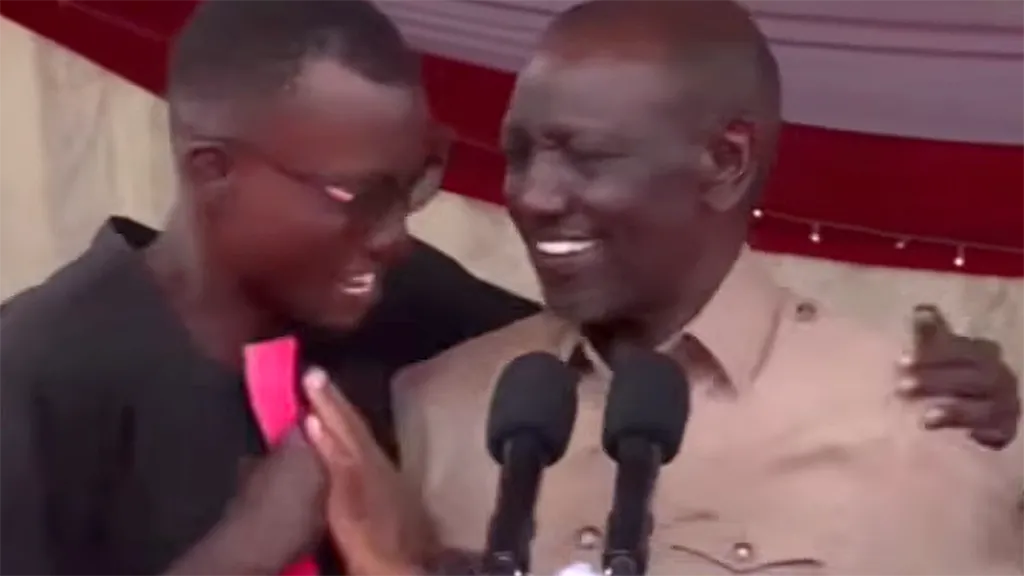
In a startling security lapse, a man managed to embrace President William Ruto during a public thanksgiving event in eastern Kenya on Sunday. The incident unfolded as the president addressed a crowd, with the individual surprisingly mounting the stage and wrapping his arm around Ruto before bodyguards swiftly intervened. Video footage of the encounter circulated widely on social media, instantly igniting concerns over the safety protocols in place to protect the head of state.
Kenya's Inspector General of Police, Douglas Kanja, deemed the security breach "unacceptable," labeling it a matter of "the gravest national concern." Following this alarming incident, Kanja ordered a complete overhaul of the President's protection team, appointing a new leader to the Presidential Escort Unit while sidelining other senior members. He emphasized the importance of adherence to security procedures at public events, stating, "Any attempt to breach security will be met with the full force of the law." Thankfully, no injuries were reported during the encounter, but the incident has sparked a wave of anxiety regarding the effectiveness of protective measures at such events.
This security incident is not an isolated occurrence; it follows a series of unsettling events that have raised eyebrows regarding the safety of Kenya's leadership. Just three months prior, a young man approached Ruto at another public engagement, prompting security personnel to intervene before any harm could be done. Furthermore, in May 2025, a shoe was hurled at the president during a rally, highlighting a troubling pattern of public confrontations that demand immediate attention. Such events not only threaten the safety of the president but also reflect broader issues concerning public safety and governance in Kenya.
The implications of this breach extend far beyond just the immediate security protocols. Citizens and political analysts alike are expressing unease over the apparent vulnerabilities surrounding presidential events, particularly in a country where political tensions often flare. The incident has generated public discourse around the effectiveness of current security measures, with many calling for a reassessment of how public gatherings are managed to prevent similar occurrences in the future. Ruto himself, appearing unfazed by the incident, commented, "Leave that young man alone. That young man has no problem," yet the gravity of the situation remains undeniable.
Looking ahead, the Kenyan public should remain vigilant as an investigation unfolds to uncover how this man bypassed multiple layers of security. Observers will closely monitor any changes to security protocols at future presidential events, especially amidst rising fears of political unrest. The government’s next steps will be crucial in reassuring the public that their leaders can operate safely in a democracy where voices are often raised, and tensions occasionally flare.